Contents
2. CONSTRUCTION WORKS INVOLVING SILT CURTAINS DEPLOYMENT
2.2.
Construction Activities Involving
Deployment of Silt Curtain
3. SILT CURTAIN DESIGN AND CONSTRUCTION SEQUENCE
3.1.
Types of Silt Curtains to be
Deployed
3.2.
Requirements for Hanging Type Silt
Curtains
3.3.
Arrangement for the Silt Curtain
Deployment Location
3.5.
Procedures for Pre-Assembly of Silt
Curtain
3.6.
Installation of Silt Curtain
4.1.
Deployment of Silt Curtain
4.2.
Operation of Silt Curtain
4.3.
Procedures for Adverse Weather
Conditions
4.4.
Maintenance of Silt Curtain
5. REGULAR CHECKING AND MONITORING
List of Appendices
APPENDIX
A CONSTRUCTION PROGRAMME INVOLVING DEPLOYMENT OF SILT
CURTAIN
APPENDIX
B SILT CURTAIN CATALOGUE AND SPECIFICATION
APPENDIX
C SILT CURTAIN LOCATIONS
APPENDIX
D SILT CURTAIN INSPECTION CHECKLISTS
APPENDIX
E IMPLEMENTATION SCHEDULE OF RECOMMENDED MAJOR ENVIRONMENTAL
MITIGATION MEASURES
1. INTRODUCTION
1.1. Background
Under the Environmental Impact Assessment Ordinance, the Environmental Impact Assessment (EIA) Report (Register No.: AEIAR-254/2023) prepared for the Airport Tung Chung Link Project (the Project) has been approved by the Environmental Protection Department (EPD). An Environmental Permit No. EP-630/2023 for the construction and operation of the Project was first granted by Director of Environmental Protection (“DEP”) to Airport Authority Hong Kong (“AAHK”) on 26 October 2023. Subsequently an application for variation of the EP was submitted on 3 November 2025 and the current valid EP (No. EP-630/2023/A, hereinafter known as “the EP”) was issued by EPD on 1 December 2025. Pursuant to Condition 2.13, AAHK shall prepare a Silt Curtain Deployment Plan
(“SCDP”) for covering construction works that involve the deployment of silt curtain under this Project.
This Project consists of constructing a 3.8km vehicular road, named as the Airport Tung Chung Link (“ATCL”). This road will extend the passenger transport services using autonomous vehicles (“AV”) from the Airport City Link (“ACL”) to Tung Chung, aiming to enhance connectivity between the Hong Kong-Zhuhai-Macao Bridge (“HZMB”) Hong Kong Port (“HKP”), SKYCITY and Tung Chung. The marine facilities in the waters between Airport Island and HKP Island, and the spur line running from the HKP Island to connect the Academy Station are included in the Project EIAR (Register No. AEIAR-254/2023) and the Project EP (EP No. EP-630/2023/A), however, the construction of marine facilities and spur line is not included in the current stage of ATCL construction. The SCDP for remaining marine works will be provided separately.
Penta-Ocean Construction Company Limited (“POC”) is the Main Contractor of the Project and responsible for the marine viaduct construction which situated in a marine area between Lantau Island and Airport Island. This Silt Curtain Deployment Plan will include the marine viaduct construction area which situated in a marine area between Lantau Island and Airport Island. The proposed marine facilities in the waters between Airport Island and Hong Kong Boundary Crossing Facilities are not included in this submission.
1.2. Project Description
The Project (under EP Permit No.: EP-630/2023/A) will comprise:
• A 2.8km at-grade section along the eastern coast of Airport Island with intermediate stops;
• An overall 1km length of viaducts consisting of three sections (a land viaduct over Tung Chung town centre, a marine viaduct between Lantau Island and Airport Island and a land viaduct connecting with ACL at HZMB HKP);
• An elevated Tung Chung Central Station (TCCS) near Tat Tung Road;
• A depot for autonomous vehicle;
• A promenade; and
• Leisure supporting facilities, and the associated ancillary buildings and facilities.
As mentioned in Section 1.1, the construction of marine facilities and spur line of ATCL (including Academy Station) as stated in the Project EIAR and the Project EP are not included in the current stage of ATCL construction and was thus not included in this SCDP”.
1.3. Purpose and Scope
As specified in Condition 2.13 of the EP:
“The Permit Holder shall, no later than 2 months before the commencement of marine works involving deployment of silt curtains of the Project, deposit 3 hard copies and 1 electronic copy of a Silt Curtain Deployment Plan (SCDP) with the Director. The Plan shall include the construction programme of marine works and details on the design, location, operation and maintenance of silt curtain(s) to be deployed during the marine works. The Plan shall be fully and properly implemented.”
This SCDP has been prepared in accordance with the EP requirements and details the requirements for implementation of silt curtains during the Project construction phase. This Silt Curtain Deployment Plan will include the construction area which situated in a marine area between Lantau Island and Airport Island.
The SCDP (Revision E) was submitted on 6 February 2026 and approved by the EPD on 24 March 2026. An Environmental Review Report (ERR) (Document No. 5232974-OR013-G) was prepared to cover the change from a temporary piling platform to a temporary rock fill platform of Bridge Pier P11. This ERR was submitted on 18 June 2026 and accepted by the EPD on 8 July 2026. Consequently, this updated SCDP (Revision F) reflects the construction sequences and silt curtain deployment requirements outlined in the accepted ERR.
1.4. Report Structure
Following the introductory section, the SCDP is structured as follows:
|
Section 2 |
|
Construction Works involving Deployment of Silt Curtain |
|
Section 3 |
|
Silt Curtain Design and Location |
|
Section 4 |
|
Operation and Maintenance |
|
Section 5 |
|
Regular Checking and Monitoring |
2. CONSTRUCTION WORKS INVOLVING SILT CURTAINS DEPLOYMENT
2.1. General
As stipulated in Section 2.7 of the approved ATCL EIA Report and Section 2.2. of the approved ERR, deployment of silt curtain has been recommended for marine construction. The marine works activities during construction phase as stipulated in Section 2.2 will involve deployment of silt curtain.
The construction of the marine viaduct would involve the installation of 4 sets of Bridge Piers (2 piles for each set, totalled 8 piles) across the Tung Chung Navigation Channel.
For Bridge Pier 8 to Bridge Pier 10, silt curtains would be installed to surround the piling area prior to setting out the temporary working platform, establishing piling equipment on barge, and installing the steel pile casing. For Bridge Pier 11, silt curtain would be installed to surround the periphery of temporary rock fill platform works area prior to the construction of temporary rock fill platform. Silt curtains will be kept in place throughout the bored piling works.
Hanging type silt curtain will be deployed to surround each set of bridge piers (Bridge Pier 8 to Bridge Pier 11) for the bored piling works. Total of 4 individual silt curtains will be provided.
The deployment of silt curtain for Bridge Pier 10 was carried out on 27 and 28 March 2026, and the marine piling works of Bridge Pier 10 will be commenced on 20 August 2026. While the deployment of the silt curtain for Bridge Pier 8 was carried out on 22 and 23 April 2026, and the marine piling works of Bridge Pier 8 was commenced on 26 June 2026. Construction programme involving deployment of silt curtains can be referred to the Appendix A.
Appendix C shows the site location and layout plan of the proposed bored piling works.
2.2. Construction Activities Involving
Deployment of Silt Curtain
The construction of the marine viaduct would involve the installation of 4 sets of bridge piers, Bridge Pier 8 to Bridge Pier 11 (2 piles for each set, total of 8 piles) across the Tung Chung Navigation Channel. At most two piles will be installed/constructed concurrently at the marine viaduct works area across Tung Chung Navigation Channel during the construction phase.
Bridge Pier 8 to Bridge Pier 10
After the installation of silt curtain(s) to surround the active marine works area, a temporary working platform that sits on mini piles would be installed. The support casings will be positioned to the seabed by vibratory hammer from a barge. Such operation is expected to result in limited level of localized disturbance to bottom sediment, particularly when controlled by the surrounding silt curtain. Upon completion of installing the temporary working platform, all subsequent piling works would then be commenced by the piling plants on the temporary working platform.
Bridge Pier 11
Further to safety review undertaken in July 2026, site constraint was identified. The installation sequence will strictly require the geotextile sheets to be laid first prior to the deployment of silt curtain. There is no change in the piling construction sequence, the piling activities will only take place after the deployment of silt curtain.
If the silt curtain is deployed first, the working radius would be larger than that without the silt curtain, the jib of the 90T Crane barge needs to be extended more for laying the geotextile, the extended jib of the 90T Crane barge will further restrict the limited marine access in Tung Chung Navigation Channel, as shifting / mooring of the 90T Crane barge needs to be further away from the shoreline because the working radius is larger. Consequently, the outreach of the 90T Crane barge will be insufficient to safely reach the landward side for subsequent geotextile laying, which might increase the risk of overturning of the jib of the crane. Therefore, geotextile installation shall be fully completed within the designated working area prior to the commencement of silt curtain deployment.
The laying of geotextile only involved the laying of cloth, not involving placement of fill materials. As no seabed disturbance, dredging, excavation, or placement of fill material will occur during geotextile installation, the works are not expected to generate significant suspended solids or water quality impacts prior to deployment of the silt curtain.
Once the silt curtain is fully deployed, rockfilling activities will be commenced. Rock fill materials will be unloaded by dump trucks on the land side and long arm excavators will be deployed to construct a stable working platform. All subsequent piling works would be conducted by piling plants on top of the temporary rock fill platform. The silt curtain will be in place during removal of the rock fill platform.
3. SILT CURTAIN DESIGN AND CONSTRUCTION SEQUENCE
3.1. Types of Silt Curtains to be
Deployed
Hanging Type silt curtain is proposed to be installed around Bridge Pier 8 to Bridge Pier 11. The following sub-sections outline the technical requirements of the silt curtain.
3.2. Requirements for Hanging Type Silt
Curtains
For Bridge Pier 8 to Bridge Pier 11, hanging type silt curtains mainly comprise the geotextile fabric with ballast chain / weight and floatation. The geotextile fabric for Bridge Pier 8 to Bridge Pier 10 shall be connected to all four sides using polypropylene rope with sufficient overlap to prevent leakage of suspended solids.
As for Bridge Pier 11, a localized silt curtain is proposed, where the assembled silt curtain will follow the outer perimeter of the proposed rock fill platform, with both terminal ends securely anchored on the seawall rock armour. The floatation is contained within a sleeve or collar with adequate buoyancy to support the full weight of the silt curtain. The bottom end of the silt curtain is weighted by a ballast chain incorporated into the hem of the silt curtain as to keep the silt curtain vertical during deployment. The geotextile fabric for Bridge Pier 11 shall be connected using polypropylene rope with sufficient overlap to prevent leakage of suspended solids.
The length of silt curtain will account for a buffer depth to ensure no gaps between the skirt of the silt curtain and seabed and cater for site irregularities and tidal variations.
To ensure the quality of silt curtain, the supplier must be quality certified (i.e. ISO 9001 or equivalent) and relevant project references / records of field tests demonstrating the silt curtains applicability for deployment in open sea marine environments and conditions comparable to those in Hong Kong waters shall be provided. Details are provided in Appendix B.
3.3. Arrangement for the Silt Curtain
Deployment Location
Prior to the construction of temporary working platforms and temporary rock fill platform, deployment of silt curtains will be carried out. Silt Curtains will be installed around the works area for prevention of water quality impacts. The marine viaduct works area is shown in Appendix C.
3.4. Pre-Condition Survey
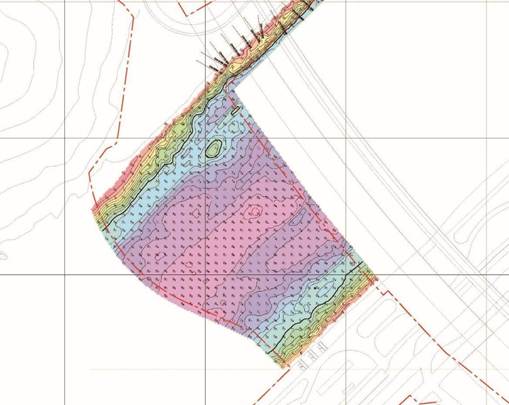
A Bathymetric Survey to check the depth of the seabed and existing seabed condition using the Multibeam Sonar was conducted on 2 February 2026. The Survey coverage was within the works area of the marine viaduct. The primary purpose of this survey is to detect any vertical anomalies (high-spots or low-spots) present on the seabed within the work area so that can pre-plan the working methodology on the marine viaduct. Aside from pre-planning of the working methodology, the length of the silt curtain can be determined. The Bathymetric Survey Result of Marine Viaduct is shown in Figure 3.1.
Figure 3.1: Bathymetric Survey Report on the Marine Viaduct
3.5. Procedures for Pre-Assembly of Silt
Curtain
1. The pre-assembly of silt curtains will be conducted on deck of a 90T Crawler Crane Barge.
2. For Bridge Pier 8 to Bridge Pier 10 silt curtains, a 15m span of pre-assembled silt curtain will be connected to a 10m span of preassembled silt curtain to form a 25m long silt curtain section. Two 25m long silt curtain sections will be connected to form a 50m long silt curtain (2 nos. of 15m span silt curtain and 2 nos. of 10 m span silt curtain).
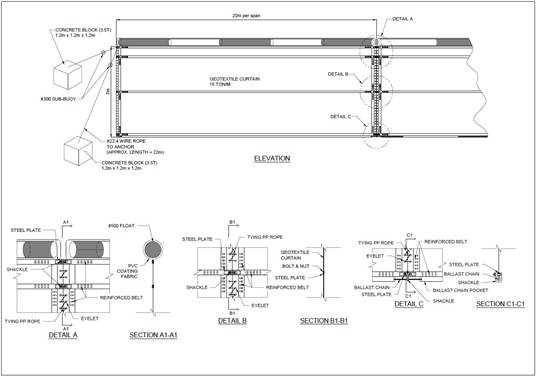
3. For Bridge Pier 11, sections of 10m span pre-assembled silt curtains will be connected to sections of 20m span of preassembled silt curtains to form a 170m long silt curtains (11 nos. of 10m span silt curtain and 3 nos. of 20m span silt curtain). Each connection of silt curtain will use the D-shackles and Polypropylene rope for stitching as shown in Figure 3.2.
4. Each pre-assembled silt curtain will be connected to another span of silt curtain using a D-shackle at the top, middle, and bottom connection points of the steel end plates.
5. The eyelets of the pre-assembled silt curtain will be threaded with a polypropylene rope in a zigzag pattern to connect the sections.
6. A ballast chain will be inserted into the chain pocket at the bottom of the preassembled silt curtain to provide weight and stability.
7. To safely secure the ballast chain pocket, a larger D-shackle will be attached to the lowest point of the connecting steel plate to support the weight of the ballast chain and avoid wear and tear on the ballast chain pocket.
Figure
3.2: Details of Stitching Two Spans of Pre-assembled Silt Curtain
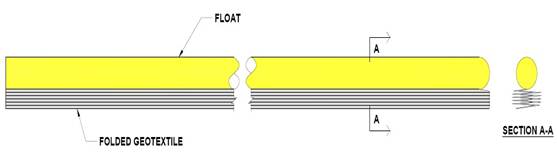
8. After interconnecting all sections of silt curtain, fold the assembled silt curtain, starting from the ballast chain pocket and working up towards the floatation end as shown in Figure 3.3.
Figure 3.3: Folded Silt
Curtain
3.6.
Installation of Silt Curtain
For Bridge Pier 8 to Bridge 10
1. Anchoring concrete blocks will be used to keep the silt curtain vertical during the deployment and would be placed at its designated positions on the seabed before launching the silt curtains into the sea.
2. Three sets of pre-assembled silt curtains loaded to the deck of 90T crawler crane barge will be towed to the Marine Viaduct area by the tugboat.
3. Upon reaching the Marine Viaduct area, the 90t crawler crane barge will drop its anchors onto the seabed. The tugboat will release its towlines once all 4 anchors of the crawler crane barge has been placed on the seabed.
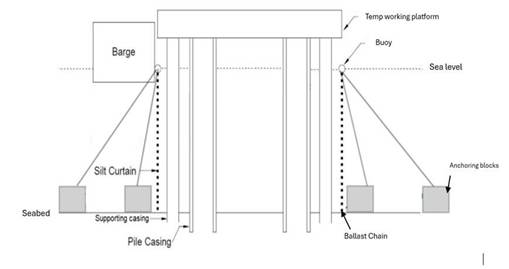
4. The crawler crane barge will moor towards the silt curtain deployment location and lower down the folded silt curtain onto the sea. Sub-buoys will be installed on the silt curtain first before the diver dives down and secure the silt curtain to the anchoring concrete blocks. Setup of silt curtain surrounding the temporary piling platform for Bridge Pier 8 to Bridge Pier 10 is illustrated in Figure 3.4.
Figure
3.4: Diagram of Silt Curtain Set Up for Bridge Pier 8 to Bridge Pier 10
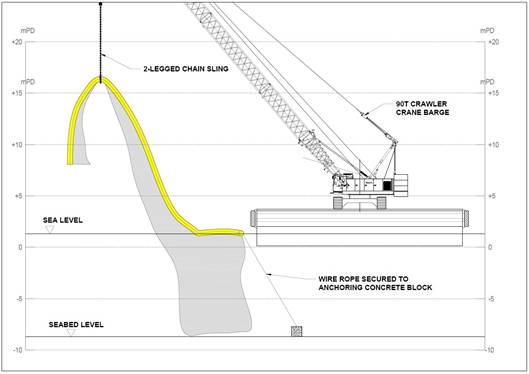
5. The crawler crane will navigate the installation position of the silt curtains (shown in Figure 3.5) to its next position and then repeat the steps until completing all 3 silt curtain positions as shown in Figure 3.6.
Figure 3.5: Navigating the Silt Curtain
Figure
3.6: Completed Installation of Silt Curtains for Pier 8 to Pier 10
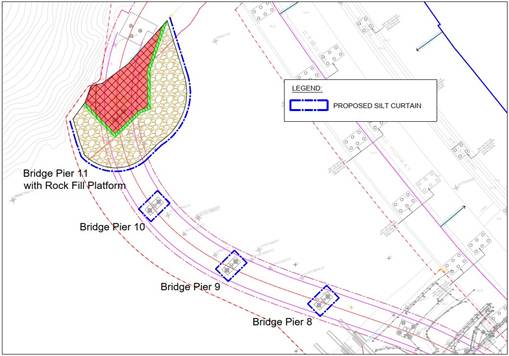
For Bridge Pier 11
Hanging type silt curtains will be deployed to surround the periphery of rock fill platform of Viaduct 2 Pier 11 prior to the construction of the rock fill platform. The sequences of silt curtain installation by a 90t Crawler Crane Barge are shown as the below stages.
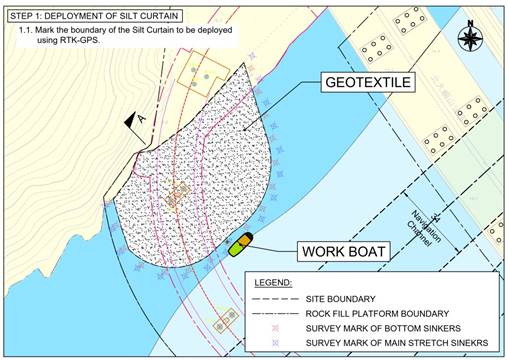
1. Setting out of the Silt Curtain Installation Boundary. Mark the boundary of the Silt Curtain to be deployed using the work boat with RTK-GPS. Figure 3.7 shows the marking of setting out points using a work boat with RTK-GPS on board.
Figure
3.7: Mark the setting out points using a work boat with RTK-GPS
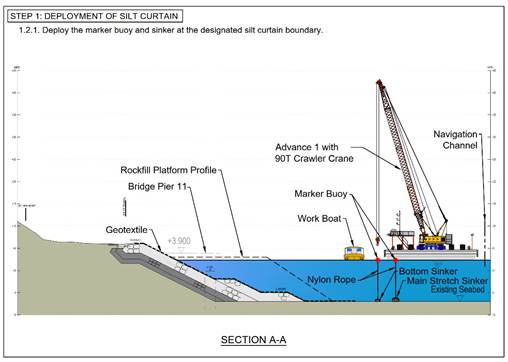
2. Installation of the silt curtain sinkers. The 90t crane will be deployed for the installation of the silt curtain sinkers according to the previously marked marker buoys. The installed silt curtain sinkers will be marked with the buoys for later connection to the silt curtain. Work boat will be used to unsecure the lifting sling of the installed sinkers. Figure 3.8 shows the installation of sinkers.
Figure 3.8: Installation of silt curtain markers by a 90t crane barge
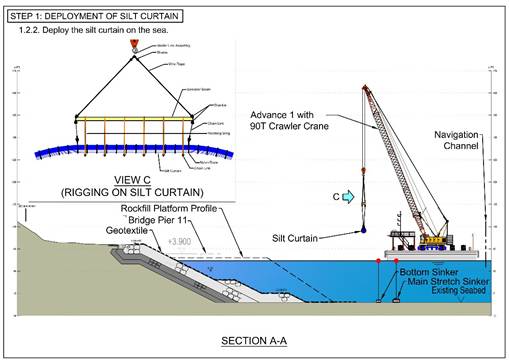
3. Lifting of Silt Curtains onto the Sea. Upon the completion of installation of silt curtain sinkers, the pre-assembled silt curtains will be lifted onto the sea by the 90t crawler crane. Figure 3.9 shows the lifting of the silt curtains. Motorized work boat will secure the buoyancy frame and interlock to the cable of main stretch mooring. After the surface frame is fixed, the mounting ropes will be cut and release the curtain skirt down to the seabed.
Figure
3.9: Lifting of silt curtains onto the sea
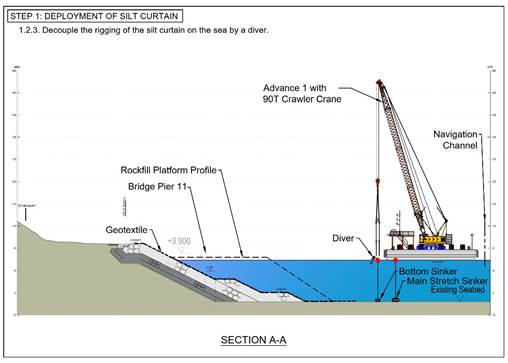
4. Decoupling the rigging of lowered silt curtains. After lowering the silt curtains onto the sea by the 90t crawler crane barge, the divers will then decouple the rigging of lowered silt curtain. Figure 3.10 shows the decoupling of the rigging by the diver.
Figure 3.10: Decoupling of the rigging after lifting of silt curtains
onto the sea
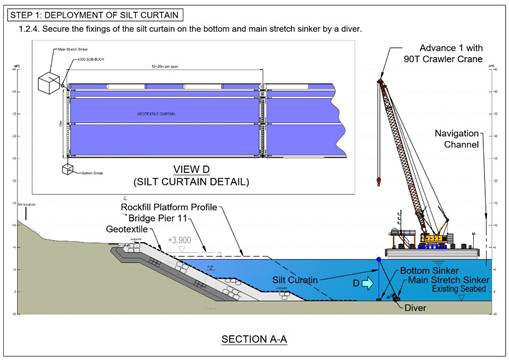
5. Securing the silt curtains to the sinkers. Once the silt curtains are stretched out and flowing on the sea, the diver will connect the silt curtains with the installed bottom and main sinkers. Figure 3.11 shows the underwater securing to the sinkers by the diver.
Figure
3.11: Securing the silt curtains with sinkers by the diver
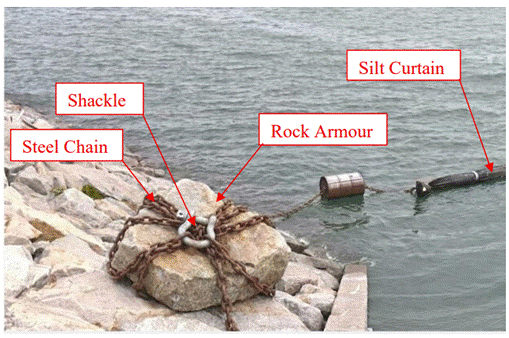
6. Both terminal ends of the silt curtain will be secured to the seawall rock armour using a heavy-duty steel chain wrapped tightly around the boulders and interlocked with a shackle as shown in this Plate 1.
Plate 1: Securing the silt curtains to
the seawall rock armour using a heavy-duty steel chain wrapped tightly around
the boulders and interlocked with a shackle
7. The layout of completion of silt curtains installation is shown in Figure 3.12. The section of the installed silt curtains is shown in Figure 3.13.
Figure
3.12: Layout of completed installed silt curtains
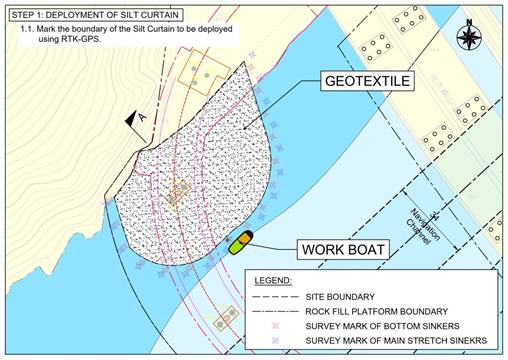
Figure 3.13: Section view of installed silt curtains
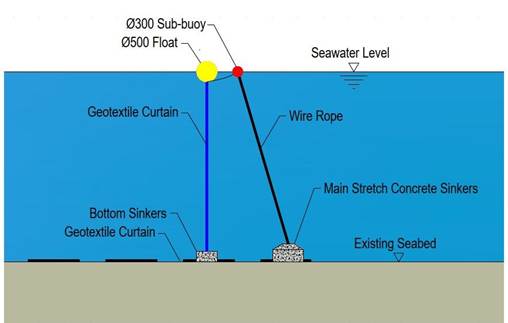
8. After the diver has completed connecting the bottom sinkers to the silt curtains, an entirely underwater inspection will be conducted.
4. OPERATION AND MAINTENANCE
4.1. Deployment of Silt Curtain
Silt curtain will be deployed at marine viaduct Bridge Pier 8 to Bridge Pier 10 prior to installation of temporary working platform, and at Bridge Pier 11 prior to construction of temporary rock fill platform. The details of work sequence can refer to Section 3.5 to 3.6.
4.2. Operation of Silt Curtain
Silt curtains will remain in place throughout the bored piling works. It will only be removed upon completion of the bored pilling works and after temporary working platform for Bridge Pier 8 to Pier 10 and the temporary rock fill platform for Bridge Pier 11 have been dismantled. Regular checking and monitoring will be carried out during the operation of the silt curtain (see Section 5).
4.3. Procedures for Adverse Weather Conditions
For Bridge Pier 8 to Bridge Pier 11, during adverse weather conditions (e.g. typhoon signal No.3 or higher), no construction works will be conducted, and the silt curtains for Bridge Pier 8 to Bridge Pier 11 will be retracted where possible to avoid unnecessary damage. After typhoon signal No.3 is lowered, the silt curtain will be re-deployed prior to re-initiation of construction works around the bridge piers.
The Contractor will ensure the silt curtain is undamaged or will repair or replace the affected silt curtain before relevant construction works are re-initiated. Re-deployment of silt curtains where required, shall follow the procedures specified in Section 3.5 to 3.6.
4.4. Maintenance of Silt Curtain
For Bridge Pier 8 to Bridge Pier 11, daily visual inspection on the silt curtains will be conducted before commencement of construction works, any damage or faults identified in the silt curtain will be repaired immediately. Where the damage / fault is minor, the Contractor will undertake in-situ maintenance and repair by qualified divers without the need for retracting the silt curtain. Where such in-situ maintenance and repair are conducted, the Contractor will ensure that another diver is on standby, the appropriate warning flags / signals are in place, and the captain or foreman of the maintenance / construction vessel has communication channels open and ready to promptly alert other vessels to avoid the affected silt curtain area during the maintenance and repair. In case of mud plume flowing out from the silt curtain causing by the works is observed, repairing of silt curtain will be carried out immediately prior to resume the relevant construction works.
Spare parts of silt curtain will be prepared and stored on-site for replacement / repair. Where the damage / fault is extensive or cannot be easily repaired in-situ, the Contractor will retrieve the silt curtain and replace with new ones. In such circumstances, the relevant construction works will be suspended until the replacement is done.
4.5. Removal of Silt Curtain
Prior to removal of silt curtains, ensure all construction works (as mentioned in section 4.2 above) within the silt curtain has completed and visual inspection of the water quality shall be conducted to confirm no sediment plume remaining within the works area before commencing silt curtain removal. The silt curtain will be lifted carefully to avoid stirring up the seabed and will be removing by a crawler crane.
5. REGULAR CHECKING AND MONITORING
5.1. Inspection
Regular checking of the silt curtain will be conducted throughout the deployment of the silt curtain. The two types of checks that will be conducted are:
● Visual – the Contractor to check that the silt curtains are maintained in the correct positions with no obvious defects / entanglement, the marker buoys / lights (where applicable) are present and operational, and there is no observable muddy water passing through the silt curtain system. Any floating refuse trapped by the silt curtain will also be removed as part of the visual inspection.
● Diver – for conducting more thorough underwater inspections to check that the silt curtain fabric is intact, the silt curtain depths are correct, and there is no damage / breakage in load lines.
The checking frequency is summarised in Table 5.1. All checks will follow the inspection checklists shown in Appendix D and will be appropriately signed off by the Contractor.
Table
5.1: Inspection Requirement and Frequency
|
Inspection |
Purpose |
Visual Inspection Frequency |
Diver Inspection Frequency |
|
Upon initial installation |
To confirm the silt curtain has been properly installed |
Daily |
Once |
|
During operation |
To maintain regular check of |
Quarterly |
|
|
When there is observed / suspected sediment release |
To identify cause of sediment release and
confirm any |
At least once for each instance |
|
|
Upon re-installation (where applicable) |
To confirm the silt curtain has been properly re-installed |
Once for each instance of re-installation |
Weekly and ad hoc site inspections carried out by the Environmental Team (ET), and also monthly site inspection conducted by the Independent Environmental Checker (IEC), will include visual checks on the silt curtain location and effectiveness. Where the silt curtains deployed are identified by the ET and / or IEC to be ineffective or inadequate for controlling sediment release, the Contractor will make appropriate adjustments or provided additional silt curtains as necessary to improve and meet the water quality requirements of the Project.
5.2. Record Keeping
All inspections carried out by the Contractor will be recorded on the silt curtain inspection checklists are shown in Appendix D. All checklists will be signed by the Contractor and kept on board the responsible maintenance / construction vessel and made available to the ET and IEC upon request for checking and auditing purpose. Diver inspection records will also be signed by the qualified diver. A summary of the records of the daily visual and the diver inspections including photographic records, as well as any rectification action taken, will be included in the Contractor’s monthly environmental reports.
An implementation schedule of key requirement of relevant mitigation measures is provided in Appendix E.